Wednesday, April 29, 2009

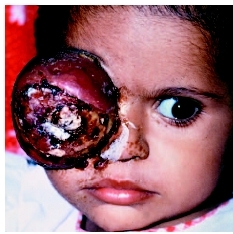
Retinoblastoma


Retinoblastoma (Rb) is a rapidly developing cancer which develops in the cells of the retina, the light sensitive cells of the eye. In the developed world, Rb has one of the best cure rates of all childhood cancers (95-98%), with more than nine out of every ten sufferers surviving into adulthood. Retinoblastoma is a very treatable cancer.

There are two forms of the disease; a genetic heritable form and a non-genetic non-heritable form. Approximately 55% of children with Rb have the non-genetic form. If there is no history of the disease within the family, the disease is labelled "sporadic", but this does not necessarily indicate that it is the non-genetic form. In about two thirds of cases, [1] only one eye is affected (unilateral retinoblastoma); in the other third, tumours develop in both eyes (bilateral retinoblastoma). The number and size of tumours on each eye may vary. The position, size and quantity of tumours are considered when choosing the type of treatment for the disease.

Swine flu by wikipedia

Swine influenza (also swine flu) refers to influenza caused by any strain of the influenza virus endemic in pigs (swine). Strains endemic in swine are called swine influenza virus (SIV).

Swine flu is common in swine and rare in humans. People who work with swine, especially people with intense exposures, are at risk of catching swine influenza if the swine carry a strain able to infect humans. However, these strains rarely are able to pass from human to human. Rarely, SIV mutates into a form able to pass easily from human to human. The strain responsible for the 2009 swine flu outbreak in humans is believed to have undergone such a mutation.[1]

In humans, the symptoms of swine flu are similar to those of influenza and of influenza-like illness in general, namely chills, fever, sore throat, muscle pains, severe headache, coughing, weakness and general discomfort. The strain responsible for the 2009 swine flu outbreak in most cases causes only mild symptoms and the infected person makes a full recovery without requiring medical attention and without the use of antiviral medicines.[2]

Of the three genera of human flu, two are endemic also in swine: Influenzavirus A (common) and Influenzavirus C (rare).[3] Influenzavirus B has not been reported in swine. Within Influenzavirus A and Influenzavirus C, the strains endemic to swine and humans are largely distinct.